If you’ve ever wondered which oven setting to use, where to put the oven rack, whether you really need to preheat, or why your food doesn’t seem to cook the way the recipe says it should, this video is for you.
I’m going to walk you through 15 things you should know about using an oven, whether you’re a beginner or you’ve been cooking for years.
I’ll show you what the different oven settings actually do, where to position your racks, how convection works, why your oven temperature might not be what you think it is, and some of the most common mistakes people make.
Watch this video tutorial for how to use an oven:
How to Use an Oven: 15 Things You Need to Know Before You Bake
Let’s get started.
1. LEARN WHAT YOUR OVEN SETTINGS MEAN
The first thing you need to understand is what all those symbols and settings on your oven actually mean.
The most basic setting is Bake.
Bake uses the heating elements to heat the oven to the temperature you’ve selected. This is the setting you’ll use for most everyday baking and cooking.
Then you may have Convection Bake.
Convection uses a fan to circulate the hot air around the oven. This can help food cook more evenly and can sometimes allow you to cook at a lower temperature or for a shorter amount of time.
You may also have Broil.
Broiling uses intense heat from the top of the oven. It’s useful for things like browning the top of a casserole, melting cheese, or getting a nice browned crust on food.
Some ovens also have settings like Roast, Air Fry, Proof, Dehydrate, or Pizza.
The important thing is not to assume that every oven setting works exactly the same way.
Your oven manual is actually worth reading, especially if you have a newer oven with specialized cooking modes.
2. BAKE VS. CONVECTION
One of the most common questions people have is: What’s the difference between regular bake and convection?
With regular bake, the air inside the oven is heated, but it isn’t actively circulated by a fan.
With convection, a fan circulates the hot air.
That circulating air can help food cook and brown more evenly.
But here’s the important part: Don’t automatically change every recipe to convection without adjusting the temperature or cooking time.
Many recipes are written for conventional baking.
A common starting point is to reduce the temperature by about 25 degrees Fahrenheit when converting a conventional recipe to convection, but your oven and the particular food you’re cooking can make a difference.
So when you’re trying a recipe for the first time, pay attention to how your oven behaves rather than blindly following a conversion.
And this is one reason it’s so helpful to understand your particular oven.
3. WHERE SHOULD YOU PUT THE OVEN RACK?
The position of your oven rack can make a surprisingly big difference.
For most baking, the center rack is a good starting point because it gives the food relatively even exposure to the heat.
But there are times when you want a different position.
If you’re broiling, you’ll usually want the food closer to the top heating element.
If you’re roasting something and want more intense heat from the bottom, a lower rack can sometimes be useful.
And if you’re baking two pans at once, you’ll want to think about how the hot air circulates around them.
One of the biggest mistakes is putting a pan wherever there’s room without thinking about the rack position.
Where you put your food in the oven matters.
4. DO YOU REALLY NEED TO PREHEAT YOUR OVEN?
For many recipes, yes.
If a recipe tells you to bake something at 350 degrees, that generally means you want the oven to actually be at 350 degrees when you put the food inside.
This is particularly important for baking because chemical reactions are happening as the food heats.
For example, cakes, breads, biscuits, cookies and other baked goods can be affected by starting them in an oven that isn’t fully heated.
There are some foods where starting in a cold oven can be perfectly fine, but if a recipe specifically tells you to preheat, I recommend following that instruction.
And don’t assume that the oven beep necessarily means everything inside the oven has stabilized at the exact temperature you need.
That brings me to the next tip.
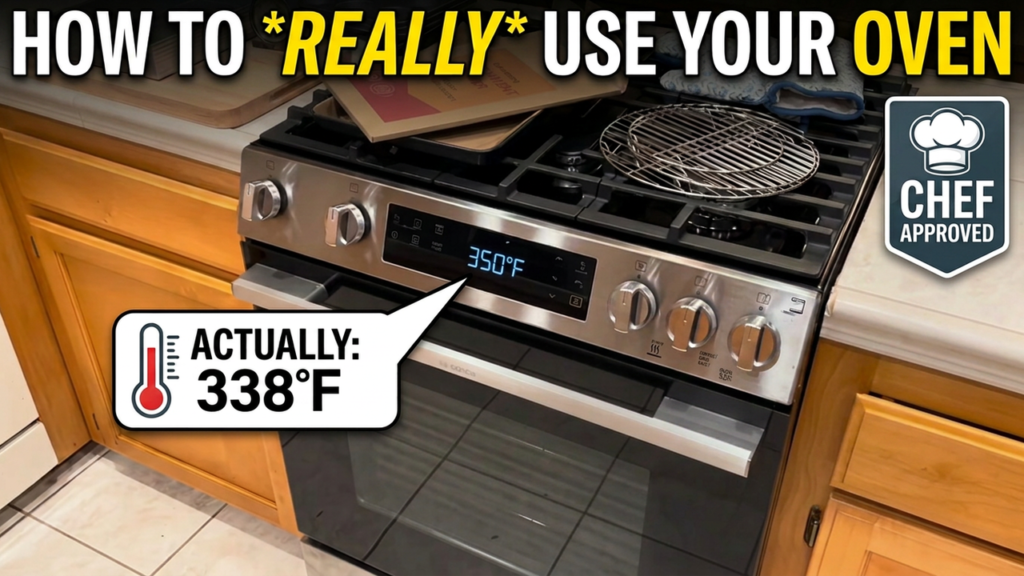
5. YOUR OVEN MAY NOT ACTUALLY BE 350 DEGREES
This is one of the most useful things you can learn about your oven.
Just because your oven display says 350 degrees doesn’t necessarily mean the air inside the oven is exactly 350 degrees at every moment.
Ovens cycle their heating elements on and off to maintain temperature.
And there can be differences between the temperature your oven displays and the actual temperature inside.
This is why I recommend having an oven thermometer.
You can put the thermometer inside the oven and compare what you’re seeing with the temperature on the oven display.
This is a relatively inexpensive tool, but it can tell you a lot about how your oven is actually performing.
If you’ve been following recipes exactly and your food is consistently undercooked or overcooked, your oven temperature is one of the things I’d check.
6. DON’T PUT YOUR FOOD IN TOO SOON
Here’s another common mistake.
The oven reaches its target temperature, you hear the beep, and you immediately put your food in.
Depending on the oven, it may be worth giving it a little additional time to fully heat.
The important thing is consistency.
If you’re baking something where temperature is critical, make sure the oven has had enough time to heat before you start.
And if you’re having problems with recipes consistently taking much longer than expected, an oven thermometer can help you figure out what’s happening.
7. GLASS, METAL, AND CERAMIC PANS ARE NOT THE SAME
The type of pan you’re using can affect how your food cooks.
Metal pans are excellent for many baking applications because they transfer heat efficiently.
Glass behaves differently.
Ceramic dishes can behave differently again.
So if a recipe tells you to use a metal baking pan and you substitute a glass or ceramic dish, don’t necessarily expect identical results.
You may need to adjust the cooking time or watch the food more closely.
This is especially important for things like cakes, brownies, casseroles and roasted foods.
The pan is part of the cooking process.
8. DON’T CROWD THE OVEN
Your oven needs room for hot air to circulate.
If you’re putting several large pans in the oven and they’re packed tightly together, you’re changing the way heat moves around the food.
This can lead to uneven cooking.
If you’re using convection, this becomes even more important because you’re relying on circulating air.
Whenever possible, leave some space around your pans.
And don’t cover every available rack with a huge pan just because your oven has multiple racks.
9. BE CAREFUL ABOUT OPENING THE OVEN DOOR
Every time you open the oven door, heat escapes.
For some foods, opening the door once isn’t a big deal.
But if you’re constantly opening the door to check on something, you’re making the oven work to recover that lost heat.
This is particularly important when you’re baking.
Instead of opening the oven repeatedly, use the oven light and window when possible.
And if you need to check something, try to do it quickly.
10. UNDERSTAND BROIL
Broil is basically a completely different cooking method from regular baking.
Instead of surrounding the food with moderate heat, you’re exposing the top of the food to very intense heat.
Broiling is fantastic when you want to brown or caramelize the surface.
You can use it for things like melting cheese, browning a casserole, crisping the top of a dish, or finishing certain meats and vegetables.
But broiling happens quickly.
You need to stay nearby and watch your food.
Something that looks perfect one minute can be burned a couple of minutes later.
And always check how your particular oven’s broiler works because ovens can differ.
11. DON’T ASSUME THE TOP OF THE OVEN IS ALWAYS THE HOTTEST PLACE
This is something that surprises people.
You might assume that the top rack is always hotter because heat rises.
But an oven isn’t simply a box where hot air rises and stays at the top.
The location of the heating elements, the oven design, the fan and the cooking mode all affect the temperature throughout the oven.
That’s another reason why rack position matters.
For everyday baking, start with the rack position recommended by the recipe.
If the recipe doesn’t specify one, the middle rack is usually a good starting point.
12. USE THE RIGHT BAKEWARE
Your choice of bakeware can make your results much more predictable.
For example, if you’re baking cookies, you might use a metal baking sheet.
For casseroles, you might use glass or ceramic.
For bread, you may use a loaf pan, Dutch oven, baking stone, or another specialized piece of bakeware.
The important thing is to understand that different materials and shapes transfer and retain heat differently.
And don’t forget that the color of the pan can matter too.
Dark pans can absorb more heat than lighter-colored pans, which can affect browning.
If you’re constantly having problems with food getting too dark on the bottom or edges, take a look at the pan you’re using.
13. WHEN SHOULD YOU USE PARCHMENT PAPER OR A SILICONE MAT?
Parchment paper is useful for lining baking sheets and pans and can make cleanup much easier.
It’s especially useful for cookies and many other baked foods.
Silicone baking mats can also provide a reusable nonstick surface.
But make sure whatever you’re using is rated for the temperature you’re cooking at.
And never assume that because something is marketed as an oven accessory that it can handle unlimited temperatures.
Check the manufacturer’s instructions.
Also remember that parchment paper should never be used under a broiler unless the manufacturer specifically says it’s safe for that application.
14. CAN YOU PUT FOOD DIRECTLY ON THE OVEN RACK?
Sometimes, but you need to know what you’re doing.
Certain foods can be cooked directly on an oven rack.
But you need to think about drips, airflow and cleanup.
If you’re cooking something that could release a lot of liquid or grease, putting it directly on the rack can create a huge mess.
And never block important vents or place things where your oven manufacturer says they shouldn’t go.
Your oven manual will tell you what is safe for your specific oven.
When in doubt, use an appropriate pan or baking sheet.
15. THE BIGGEST OVEN MISTAKE: ASSUMING YOUR OVEN IS THE SAME AS EVERYONE ELSE’S
This is probably the most important thing I want you to take away from this video.
Two ovens can both be set to 350 degrees and still cook food differently.
They can have different heating elements, different airflow, different rack positions and different calibration.
Your bakeware can also change the results.
So if you follow a recipe and something doesn’t come out exactly right, don’t automatically assume the recipe is wrong.
Pay attention to your oven.
Does it run hot?
Does it run cool?
Does food brown more on one side?
Does the top cook faster than the bottom?
Once you understand how your oven behaves, you’ll become much better at adjusting recipes and cooking times.
A FEW BASIC OVEN RULES TO REMEMBER
Before we finish, here are the basic rules I recommend remembering.
Preheat when the recipe calls for it.
Use the rack position recommended by the recipe.
Understand the difference between regular bake and convection.
Use an oven thermometer if you want to know whether your oven temperature is accurate.
Don’t overcrowd the oven.
Don’t repeatedly open the door while food is cooking.
Watch food carefully when using the broiler.
Use bakeware appropriate for the food you’re making.
And most importantly, learn how your particular oven behaves.
CONCLUSION
So those are 15 things I think every home cook should know about using an oven.
And if you’re someone who has always wondered why your food doesn’t come out exactly like the recipe, start by looking at your oven temperature, your rack position, your bakeware and your cooking setting.
Those four things can make a bigger difference than you might think.
I’ll be making more videos about ovens and how to actually use all of these settings and features, including specific videos about convection cooking and the features on my Bosch oven.
Learn more about the Bosch 100 series oven at Lowe’s >
So if you’re trying to get better results from your oven, make sure you subscribe.
And I’ll see you in the next video.
Further reading:
- 15 Kitchen Appliances I Own: Which Ones Are Worth It?
- How to Use Your Oven’s Air Fry Function for Faster Meal Prep
Pin this post on Pinterest: